The EU AI Act is not just another piece of legislation. It's a line in the sand. For marketers, automation leads, and business strategists, this is the regulation that will shape what tools you can use, how you use them, and what risks your systems carry across the next ten years.
Passed in 2024 and already partially in force, the EU act on artificial intelligence introduces the world’s first binding legal framework for artificial intelligence. Its impact? Global. Any company using AI that affects people in the European Union falls under its scope, regardless of where that company is based.
This is what experts call the Brussels Effect. A regional law that becomes the global benchmark because the market is too big to ignore. If your software personalizes content, automates pricing, or uses chatbots to drive conversions, the EU just got a say in how you operate.
Unlike GDPR, which focused on privacy, the EU AI Act digs into the design and use of AI itself. It classifies systems by risk, bans harmful use cases outright, and sets heavy requirements for transparency and oversight. The penalties are steep, but the operational disruption is steeper if you wait too long.
Marketing and automation teams can’t afford to look away.
The EU AI Act is officially known as Regulation (EU) 2024/1689, and it’s the first law of its kind to create legally binding rules for the development, deployment, and use of artificial intelligence across an entire economic bloc.
The law doesn’t just apply to companies inside the EU. It applies to any organization whose AI systems impact people within the EU, whether those systems are used for marketing, hiring, credit scoring, or customer service. If your chatbot speaks to a French customer or your ad algorithm profiles someone in Germany, you're covered. That’s the Brussels Effect in action.
At its core, the EU AI Act is about control and accountability. Its goals are to foster trustworthy AI, protect fundamental rights, and ensure safety and transparency in how intelligent systems are used. This isn’t just a compliance framework. It’s a statement: AI must serve people, not the other way around.
The regulation draws a sharp line between use cases that empower and those that manipulate. Systems that exploit users’ vulnerabilities, deceive through fake content, or socially score individuals are out. Tools that assist but remain transparent and fair are in, with clear rules attached.
To make sense of the variety of AI tools out there, the Act introduces a four-tier risk model:

Misclassifying your system or ignoring the classification process altogether could be costly. The Act introduces financial penalties of up to €35 million or 7% of global annual turnover, whichever is higher, for the most serious violations.
And there’s more than money at stake. Missteps could force product withdrawals, halt key business processes, or cause long-term reputational damage. That’s why smart companies are already auditing their AI portfolios and redesigning workflows to align with these risk levels.
Next, we’ll look at what this actually means for marketing — because yes, chatbots and content tools are now under regulatory scrutiny too. And not all use cases are treated equally.
For years, marketers have used AI to target, personalize, and scale campaigns faster than ever. But with the EU AI Act now in force, those same tools are under a legal microscope. What was once a gray area is now divided into what’s allowed, what’s restricted, and what’s banned altogether.
The EU AI Act bans any AI system that manipulates people’s behavior in ways that cause harm, especially when it targets vulnerable groups like children or people with disabilities. That includes systems designed to exploit psychological patterns, create synthetic influencers without disclosure, or push decisions through deceptive interfaces. Social scoring systems and real-time emotion recognition in public settings are also prohibited under the law (Regulation (EU) 2024/1689).
If you’re using AI to nudge behavior, you need to be confident that it’s empowering — not coercive.
Some marketing applications are not banned, but they are classified as high-risk. These include systems used to determine access to credit or insurance, tools used in recruitment or employee evaluation, and algorithms that support political microtargeting. In these cases, marketing overlaps with social impact, and the law requires developers and deployers to meet strict conditions: detailed documentation, human oversight, accuracy testing, and a clear fallback process in case the system fails.
If your marketing stack supports financial services, healthcare, education, or civic engagement, this is not a theoretical risk. You may be in regulated territory already.
Most customer-facing AI in marketing falls under the limited-risk category. This includes:
These tools are still allowed — but they now come with transparency requirements. If a user is interacting with AI rather than a human, they must be told. If content was generated by a system rather than a person, it must be labeled accordingly. Failure to disclose this information could lead to penalties under the AI Act, even if the content itself is harmless.
Transparency in AI marketing isn’t just a best practice — it’s a legal requirement. The EU AI Act obliges companies to provide clear disclosures, understandable explanations, and meaningful ways for users to opt out or contest automated decisions.
In practice, this means:
These rules aim to restore trust. If users don’t understand how your system reached a conclusion — or if they feel misled — the legal consequences could be severe.
Even if your system is compliant with the EU AI Act, that doesn’t exempt you from GDPR obligations. In fact, the two frameworks overlap significantly when it comes to profiling, data processing, and consent.
For example, if your personalization engine relies on behavioral data, you still need explicit consent under GDPR. If it makes decisions about pricing or eligibility, those decisions may also be subject to explanation rights under both laws.
The safest approach is to treat every AI-driven customer touchpoint as dual-regulated. Map the risks under the EU AI Act — then validate that your data practices also hold up under GDPR.
The EU AI Act does not just regulate flashy marketing tools or public-facing chatbots. It goes deeper, targeting the infrastructure that powers business operations. If your company uses AI to make internal decisions — about hiring, compensation, credit risk, or process control — that automation is now subject to intense scrutiny.
Several categories of business automation fall squarely under the high-risk designation. These include:
These systems must meet rigorous compliance standards. That includes pre-deployment testing, risk assessments, and maintaining a detailed technical file describing how the AI was built, trained, and validated (Regulation (EU) 2024/1689).
If your AI automates decisions that materially affect people or services, you must be able to prove how it works. That means generating:
The EU AI Act makes it clear: automation without accountability is no longer acceptable. Businesses are expected to integrate human oversight directly into system design — not just as a failsafe, but as a standard part of operation.
Unlike other regulatory checklists, the EU AI Act frames compliance as a continuous process. Systems that were compliant at launch may need to be re-evaluated as they evolve or as new risks emerge. Businesses are expected to monitor, report, and revalidate their systems regularly. If an update changes how your model functions or introduces new capabilities, you may need to file updated documentation or undergo a fresh conformity assessment.
The law also introduces obligations for companies that build or integrate general-purpose AI (GPAI) systems — like foundation models or pretrained engines — into their automation stacks. If you use a third-party AI tool to make decisions, you share responsibility for its performance, risks, and transparency.
In other words, you can’t just pass the blame to your vendor.
You’re required to understand how the model was trained, what data it uses, and whether it complies with the Act’s standards. If you fine-tune or deploy it in a high-risk setting, your obligations increase even further.
For companies using AI to streamline operations, this shift is significant. Compliance is not just about the tools you build — it’s also about the ones you buy, customize, and connect to customer data.
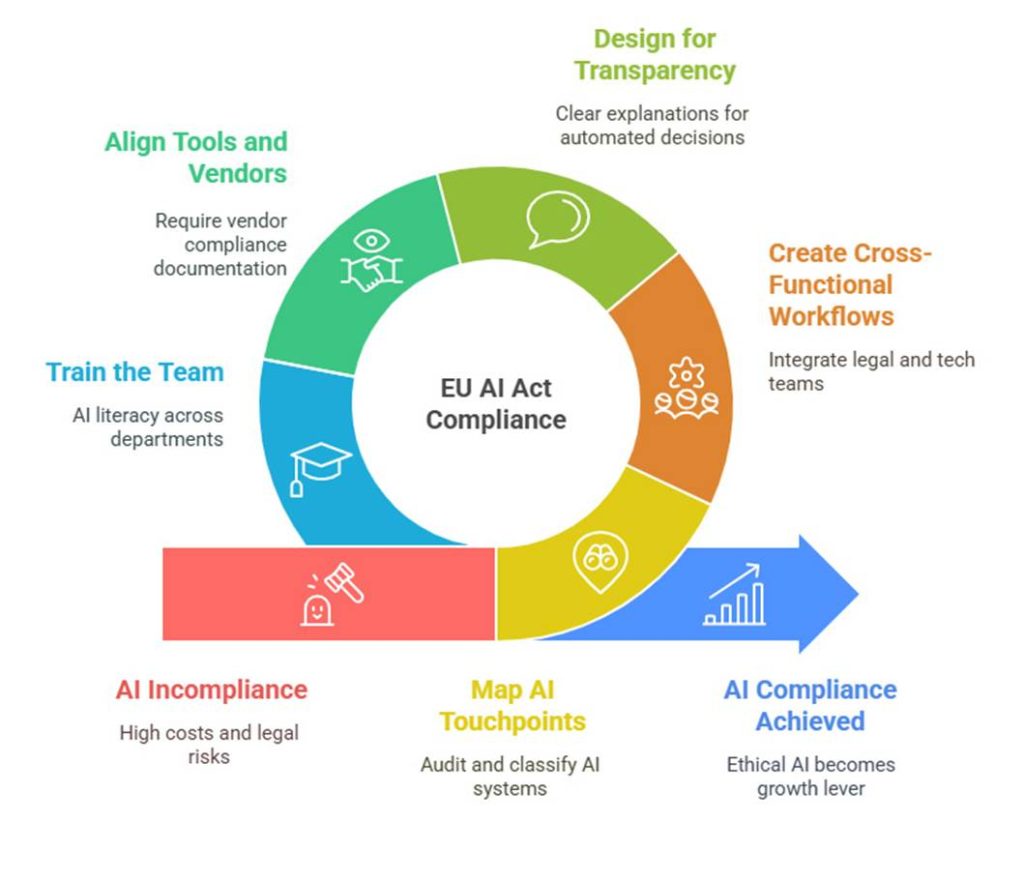
The EU AI Act isn’t about tweaking a few privacy policies. It forces companies to build permanent internal infrastructure for accountability. Compliance spans documentation, team structure, vendor management, and daily operations — and if your company uses AI in high- or limited-risk settings, this will not be cheap or quick.
Every high-risk AI system must be backed by a comprehensive technical file. This includes a general description of the system, the intended purpose, performance metrics, testing procedures, data sources, model architecture, and risk mitigation strategies. This documentation must be updated throughout the AI system’s lifecycle (Article 11).
Before deployment, the system must pass a conformity assessment — either through internal checks or, for many high-risk use cases, via a third-party notified body. Vendor audits also become mandatory if you rely on external developers, meaning your procurement teams now need legal-grade documentation from every AI partner (Article 43).
Compliance isn't just paperwork. It's governance. Companies must create internal frameworks to manage AI risks from development through post-market monitoring. That includes processes for classifying AI systems, conducting risk assessments, ensuring human oversight, and reviewing logs and incidents on a regular basis (Article 9, Article 61).
Cross-functional governance teams must be in place to operationalize these workflows. Legal, data, and engineering teams need to be involved early — not just during final review.
The Commission’s own analysis estimates that the average cost of compliance for high-risk AI systems is between €100,000 and €400,000 per system, depending on complexity (Impact Assessment Annexes). For SMEs, that can represent 30–40% of expected profit from a single product.
Annual costs don’t disappear either. Ongoing risk management, monitoring, documentation, and governance reporting average €38,000–€85,000 per year for most high-risk providers.
This isn’t speculation. These costs are now part of budget forecasts and investor risk models for companies operating in or selling to the EU.

Before anything else, compliance starts with an audit. Companies must map every AI system they use — customer-facing or internal — and classify each one based on the Act’s four-tier risk framework.
That means tracking:
Tools like chatbots, personalization engines, lead scoring models, and automated content generators all require classification. Many of them land in the limited-risk category — which still comes with transparency rules.
Because AI touches both technical and ethical domains, compliance can’t be siloed. Businesses must build new workflows that include:
These workflows must be codified into daily operations — including triggers that force a compliance review if the system is modified, retrained, or repurposed.
Transparency is one of the law’s most visible obligations. The EU AI Act requires companies to clearly inform users when they’re interacting with AI and give them understandable explanations for automated decisions (Article 52).
But the law goes further than checkbox disclosures. Explanations must be “clear, concise, and intelligible.” That means legal teams don’t just write privacy terms — UX designers must collaborate to ensure those terms are actually seen, read, and understood.
If your transparency depends on fine print, you are not compliant.
Buying or integrating external AI tools? The risk transfers to you.
You must require vendors to provide documentation about:
If a vendor cannot show proof of compliance, or cannot tell you where its data came from, you are putting your entire business at risk.
Questions to ask every vendor:
If the answer is “we don’t know” — walk away.
AI literacy is no longer a competitive advantage. It’s a legal requirement. Your team — across departments — must understand what the EU AI Act demands and how their role fits into that picture.
Product managers must know which features trigger transparency obligations. Developers need to know how to implement risk controls. Legal teams must be fluent in Article references, and customer support must be ready to explain AI outputs to end users.
Training isn’t a one-time workshop. It must be baked into onboarding, reinforced through refreshers, and adapted as the law evolves. Businesses that treat training as an afterthought will fall behind — or be fined.
The EU AI Act sets legal boundaries, but ethics will define which companies thrive in the new AI economy. As regulations force transparency, fairness, and accountability into product workflows, the companies that treat these principles as strategic advantages — not obligations — will stand out.
Compliance is now a baseline. Customers, regulators, and partners expect more than just legal adherence. They want to know that your AI tools respect users, avoid bias, and offer recourse. This isn't just a B2C issue either. In enterprise sales, government procurement, and regulated sectors like finance and healthcare, ethical AI governance is becoming a selection criterion. If your system can’t explain how it works or who controls it, you may not even make the shortlist.
Forward-looking brands are already embracing this shift. They're embedding transparency into UX, publishing explainability statements, training cross-functional teams on AI risk, and showcasing their internal oversight frameworks. These aren’t just PR moves — they’re competitive signals.
Done well, ethical AI becomes a growth lever. It attracts customers, reassures investors, simplifies audits, and future-proofs operations. The EU AI Act may have forced the conversation, but the real win goes to businesses that lead it.